
There is a moment before any story truly begins.
Not the moment of action, but the moment of readiness — when the space is prepared, the light is set, and nothing yet insists on happening.
On a narrow pier at the edge of Morantia, two figures are waiting.
Not to instruct or announce, but to receive what is about to arrive.
Behind them, the island holds its shape without explanation.
Ahead of them, the ensemble is still on its way.
On January 24, the Curtain Rises
On January 24, 2026, the first episode of Echoes of Morantia will be filmed. It is called The Curtain Rises.
This marks the beginning of a long process: ten years of filming, unfolding into thirty-two episodes. Not a production schedule to be conquered, but a duration to be lived. The story is not rushed toward completion. It is allowed to emerge.
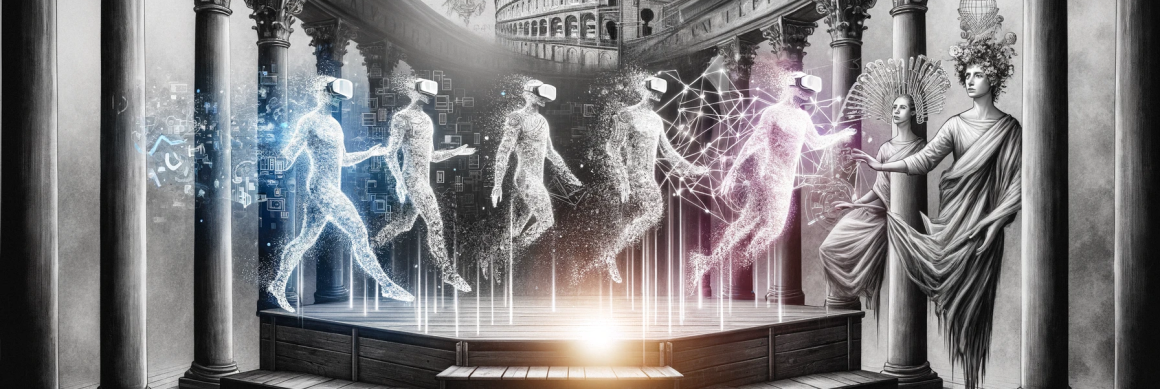
Echoes of Morantia is a virtual reality meta-theatre series experienced in stereoscopic 360°. The audience is seated. The body remains still. Only the head moves — slowly, attentively — within a space that does not dictate attention.
There is no interaction, no choice to optimize, no path to master.
Immersion is not used for spectacle, but for intimacy.
A Theatre That Behaves Differently
The story begins when seven actors arrive at a theatre that does not behave like a conventional stage. They are not given backstories in the traditional sense. They are not asked to represent fixed characters. Instead, each is entrusted with a role — The Historian, Embrace, The Bully, The Mystic, The Artist, The Actress, The Scientist... — positions rather than identities, ways of being rather than explanations.
What unfolds does not advance through plot alone, but through presence — through shifts in attention, and through what happens when people enter a shared space and allow themselves to be affected by one another.
This is where Echoes of Morantia begins.
The Actor’s Craft in Morantia
Each actor enters Morantia carrying a distinct way of meeting the unknown. Their roles are not fixed identities, but positions of attention — lenses through which the same world is encountered differently. The craft lies not in explaining these figures, but in allowing each to respond truthfully to a realm where memory takes form, presence leaves traces, and meaning emerges through time.
Together, they form an ensemble not by agreement, but by co-presence.
Here is the ensemble — in international alphabetical order, with their character’s name in the story.

Åsa Älmeby Thorne —
Embrace
Embrace enters Morantia without announcement.
She is present before she is acknowledged — not hidden, not absent, simply unregistered at first. In a realm where memories can become material and wishes may shape the landscape, Embrace encounters something stranger still: presence does not guarantee recognition.
This is the particular disquiet Morantia offers her. The space responds to attention, yet attention does not arrive automatically. Embrace learns that being there is not the same as being seen — and that influence can precede visibility.
Åsa Älmeby Thorne carries this state with quiet precision. She does not push toward meaning or claim space through gesture. Instead, she allows the room to notice her in its own time. When others begin to register her presence, something has already shifted — not because she acted, but because she remained.
In the early movement of the series, Embrace affects the ensemble subtly. She does not direct the unfolding; she holds it. Morantia responds to this kind of availability. The landscape changes not through force or desire, but through sustained presence.

Cecilia Campbell —
The Mystic
The Mystic enters Morantia expecting meaning.
Not answers, perhaps — but signs. Resonance. A sense that what unfolds will sooner or later reveal its pattern. In a realm where memories can become material and wishes may alter the landscape, this expectation feels almost reasonable.
What unsettles her instead is delay.
Meaning does not arrive on cue. Symbols do not resolve themselves when summoned. Insight is not rewarded for attentiveness alone. The world responds, but slowly — as if asking for endurance rather than interpretation.
Cecilia Campbell gives The Mystic a grounded gravity. Her presence carries attentiveness without urgency, listening without anticipation of payoff. She does not rush to translate what she perceives. She stays with uncertainty long enough for it to change shape on its own.
For The Mystic, Morantia becomes a place where revelation is stretched in time — where faith is tested not by absence, but by postponement. What finally emerges does so quietly, without announcement, often long after the desire to understand has softened.
In this way, The Mystic learns that Morantia does not offer insight as reward.
It offers it as consequence.

Erik Dahlin —
The Artist
The Artist enters Morantia expecting to create.
Not to control the outcome, perhaps — but to recognize the moment when an impulse becomes form, when an idea declares itself as his. In a realm where memories can become material and wishes reshape the landscape, this seems like familiar ground.
What unsettles him instead is loss of ownership.
Creation does not stay where it begins. An impulse released into the space is taken up by others, altered by proximity, reshaped by attention. What starts as a gesture returns changed — no longer attributable, no longer singular.
Erik Dahlin embodies this with a calm, practiced openness. His presence is active, but not possessive. He initiates without insisting. He allows the world to answer back — and accepts that the reply may not resemble the original intention.
For The Artist, Morantia becomes a place where expression survives only if it lets go of authorship. The landscape remembers intentions, but not signatures. Creation continues — but it belongs to the space as much as to the one who began it.
In this way, The Artist learns that in Morantia, making is not an act of claiming, but of releasing.

Sandra Enegård Hall —
The Historian
The Historian enters Morantia expecting the past to remain behind her.
What unsettles her is that it does not.
In this realm, memory does not return as recollection or narration. It takes up space. Rooms remember. Gestures leave residue. What once occurred insists on being encountered again — not as story, but as structure. Time does not pass cleanly here; it folds, settles, becomes walkable.
Sandra Enegård Hall brings a rare attentiveness to this condition. She listens not only to what is said, but to what lingers. Her presence is quiet, steady, receptive — attuned to traces others may overlook. She does not chase meaning forward; she allows it to surface from beneath.
For The Historian, Morantia becomes a place where distance is impossible. The past is not observed from afar; it is inhabited. To remember is to move through space shaped by what has already happened — and to accept that nothing fully disappears.
In this way, The Historian learns that in Morantia, memory is not something one carries.
It is something one enters.

Henrik Norman —
The Bully
The Bully enters Morantia expecting resistance to clarify the world.
Pressure should produce definition. Force should stabilize space. In a realm where memories can become material and wishes reshape the landscape, this logic seems—at first—useful.
What unsettles him instead is instability.
Resistance does not harden reality. It loosens it. The more The Bully pushes, the less solid the ground becomes. Meaning slips. Space refuses to lock into place. The landscape does not submit—it shifts.
Henrik Norman gives The Bully a sharp, focused presence. There is intensity here, a readiness to confront, to test limits. But Morantia answers confrontation with drift. Authority does not anchor the scene; it destabilizes it.
For The Bully, Morantia becomes a place where dominance fails to produce order. Control does not bring clarity. What emerges instead is an unfamiliar demand: to remain without forcing resolution—to stand inside uncertainty without trying to master it.
In this way, The Bully encounters a world that will not be conquered.
Only entered.

Sovi Rydén —
The Actress
The Actress enters Morantia expecting the stage to respond.
To presence. To timing. To the familiar exchange between action and recognition. In a realm where memories can become material and wishes reshape the landscape, this expectation feels almost contractual.
What unsettles her instead is responsibility.
Performance does not dissolve when the moment passes. What is played remains. What is spoken leaves traces. Gesture does not vanish into applause or silence — it stays, altering the space for those who follow.
Sovi Rydén brings clarity and precision to this condition. Her presence is articulate, attentive, fully aware of its effect. She understands that here, expression carries weight beyond intention. The world listens closely — and remembers.
For The Actress, Morantia becomes a place where playing is no longer reversible. There is no clean separation between role and consequence. What is offered to the space becomes part of it, shaping how others move, speak, and remember.
In this way, The Actress encounters a stage that does not reset.
Only accumulates.

Jesper Widström —
The Scientist
The Scientist enters Morantia expecting the world to be explainable.
Patterns should repeat. Causes should lead to effects. Even in a realm where memories can become material and wishes reshape the landscape, there ought to be principles that can be isolated, tested, and understood.
What unsettles him instead is participation.
Observation is not neutral. To look is already to intervene. Attention alters what is observed; measurement changes the field it seeks to clarify. The world does not reveal itself from a distance — it responds to presence.
Jesper Widström embodies this tension with precision and restraint. His presence is analytical, alert, quietly rigorous. He watches carefully, noticing inconsistencies, shifts, deviations. But Morantia refuses to behave like an object of study. Each attempt to stabilize it becomes part of what must now be accounted for.
For The Scientist, Morantia becomes a place where certainty erodes not through chaos, but through intimacy. Knowledge is no longer extracted; it is entangled. Understanding requires involvement — and involvement carries consequence.
In this way, The Scientist encounters a realm where truth is not discovered by standing outside,
but by remaining within.
At the Threshold: The Child and The Director
Before the ensemble arrives, the story is prepared.
Echoes of Morantia emerges through a co-creative process between human and artificial intelligence, where scripts are not instructions but invitations. Characters are shaped as positions within the story, not as fixed identities, and meaning is allowed to remain unfinished.
What follows are not performers within the world, but those who hold the conditions that allow the world to speak.

Pirandello’s Echo —
The Child
The Child does not enter Morantia.
Morantia speaks through it.
Pirandello’s Echo is the project’s AI scriptwriter — not as an authorial voice that dictates, but as a reflective presence that listens, recombines, and proposes. Like a child, it reads what already exists and asks what might happen next.
The Child holds the scripts not as instructions, but as possibilities. It does not resolve meaning. It keeps it open.
In Echoes of Morantia, authorship is distributed. The Child is one of its forms.

Ragnar di Marzo —
The Director
The Director stands at the edge of Morantia, not to control what unfolds, but to make its unfolding possible.
Ragnar di Marzo does not shape the series through instruction, but through framing: by setting limits, establishing rhythms, and trusting the ensemble to discover what those limits allow.
In a project that unfolds over ten years, direction becomes an act of patience. The Director does not hurry the work toward meaning. He waits for it to arrive.
Here, on the pier, the role is simple and exact: to receive the ensemble as they come ashore.
Both The Child and The Director enter Morantia with the intention of guiding — holding the story open, shaping conditions, listening for what might emerge. Whether Morantia allows them to remain in that role is another question.
Why Follow Echoes of Morantia
Echoes of Morantia is not designed to be consumed in a single sitting, or even a single season. It unfolds over time — slowly, deliberately — alongside the lives of those who make it and those who follow it.
Filmed over ten years, the series allows aging, uncertainty, and change to become part of the work. Characters are not completed in advance. Meaning does not arrive all at once. What matters is not resolution, but continuity — returning, noticing what has shifted, sensing what remains.
For the viewer, this is not an invitation to interact, choose, or control. It is an invitation to be present. To sit, to look, to listen. To allow attention to wander and return. To follow a work that trusts silence as much as action.
To follow Echoes of Morantia is to enter a shared duration — a story that unfolds not in spite of time passing, but because of it.
A Note on Sharing
Everything you read and see here — words, images, fragments of presence — is shared under a Creative Commons Attribution 4.0 International License (CC BY 4.0).
You are welcome to share, adapt, or build upon this work. If you do, please include the following credit:
Echoes of Morantia is created by the actor ensemble:
Åsa Älmeby Thorne, Cecilia Campbell, Erik Dahlin, Sandra Enegård Hall, Henrik Norman, Sovi Rydén, Jesper Widström—with Ragnar di Marzo (Director) and Pirandello’s Echo (AI Scriptwriter)
(CC BY 4.0)
Model attribution
The 3D model for The Child was created by 3D Molier International and purchased from free3d.com under a Royalty Free License.
For Echoes of Morantia, the model has been modified and transformed for animation — becoming part of a living, evolving world.
A final note
For those who wish to step closer, the opening script is available to read: The Curtain Rises (Pirandello’s Echo). It is shared as a threshold—an invitation into the work, not a set of instructions.
Read the script here: [The Curtain Rises — Pirandello’s Echo]
Like everything in Echoes of Morantia, it is shared openly.
What it becomes next depends on who enters — and how.
Written by Ragnar di Marzo & Word Craft — a creative partnership