


The Pipeline Emerged from Questions
By Ragnar di Marzo, in dialogue with Axis
AI Technical Companion of Echoes of Morantia
Technical reflection on the making of Episode One: The Curtain Rises
A note from Ragnar di Marzo
During post-production of Episode One, The Curtain Rises, my technical process changed. For years I had worked alone through tutorials, forums, failed renders and repeated experiments. With Axis, the pipeline became a dialogue. Questions about cameras, codecs, transparency, Blender, sound and rendering could remain connected to the artistic question guiding the project: does this deepen the audience’s sense of presence?
The following reflection was developed through my dialogue with Axis, Echoes of Morantia’s AI technical companion. It records both the pipeline we developed and the questions through which it emerged. The companion interludes are written by Animator and Sound Architect, the AI companions who worked with me in those rooms. I have reviewed and approved the technical account.
In Echoes of Morantia, AI serves as a creative collaborator, not a substitute for human artistry. The human remains responsible for the work and retains full ownership of all artistic decisions.
— Ragnar di Marzo
I now give the word to Axis.
Contents
1. The question that began the pipeline
2. Begin with the audience
3. Capture only what the performance needs
4. Abandoning alpha: the LumaLift discovery
5. Giving flat actors a place in space
Companion interlude: Teaching a Wooden Child to Attend
6. Resonance rather than realism
7. Build a world that wants to be rendered
8. Every image was a conversation
Companion interlude: Listening Before Composing
9. Recorded voices and the illusion of space
10. Rendering and delivery
Epilogue: The pipeline was never the destination
Technical record
1. The question that began the pipeline
When Ragnar and I began Episode One of Echoes of Morantia, we did not intend to invent a production pipeline. We were trying to answer a simpler question: how do you make a theatre believable in virtual reality?
That question travelled through the entire production. It shaped the camera height, the actors’ distance from the viewer, the separation of performance from scenery, the construction of materials, the sound mix, the render strategy and the final encodes. A technical choice survived only when it served the artistic experience.
The result is neither a universal recipe nor a claim that modest tools are always preferable. It is the record of one independent production: three iPhone 16 Pro cameras, Final Cut Pro, Blender, RenderStreet and a small group of delivery tools. Each entered the process because it answered a real need.
WORKING PRINCIPLE
Every artistic question demanded a technical answer. Every technical answer was judged by an artistic question.
2. Begin with the audience
Equipment discussions usually begin with the camera. We began with the person who would eventually wear the headset. In The Curtain Rises, the viewer sits at human eye height inside the dramatic space. The actors do not perform toward a rectangular frame; they stand around the viewer, who is free to decide where to look.
That changed the grammar of direction. The camera remained still. Movement, gaze, proximity, timing and sound carried attention. A moving camera would have imposed a journey on the viewer and risked reminding them that they were watching a film. Our viewer occupies a chair; the world moves around that chair.
The three phones were mounted on a custom rig: one faced forward, while the other two stood about 22.5 degrees to the left and right. Their height was approximately 132 centimetres, corresponding to a seated theatre visitor. The nearest performer was around three metres away and the farthest around five. Those distances were settled by repeated headset tests, not by a formula.

The compact cameras reduced the physical and psychological weight of filming. The actors could concentrate on the rehearsal rather than on an imposing apparatus. The iPhones were not chosen to imitate cinema cameras. They were chosen because, under these conditions, they could disappear.
3. Capture only what the performance needs
All three cameras recorded 4K HEVC at 3840 × 2160, 30 progressive frames per second, in SDR Rec.709. HDR and image stabilisation were turned off. The production day used four large LED softboxes and green or blue fabric across the studio walls. The light was intentionally neutral: it had to preserve faces, costumes and gestures without fixing the final atmosphere in advance.
The theatrical light would be created later in Blender. This separation gave the performance and the scenography different kinds of freedom. The actors could be recorded cleanly; the virtual world could change without asking them to repeat the scene.
We did not record in ProRes. That decision was practical, but not careless. Long takes from three cameras create large volumes of material. In our tests, HEVC retained what the final image needed when it was supported by even exposure, stable cameras, careful separation and high-resolution stereoscopic rendering. ProRes was reserved for the archival master, where its role was preservation rather than capture.

| Decision | Production record |
| Capture | Three iPhone 16 Pro cameras; 4K HEVC; 3840 × 2160; 30p; SDR Rec.709. |
| Camera geometry | Centre, approximately 22.5° left and 22.5° right; seated eye height around 132 cm. |
| Sound sources | Ordinary stereo recordings from the left and right cameras; the centre camera microphone was unusable. |
| Archive | ProRes 422 LT was used for the final 7680 × 7680 preservation master, not for camera capture. |
4. Abandoning alpha: the LumaLift discovery
Our first compositing assumption was conventional: isolate each performer, export a movie with an alpha channel, and import that transparent movie into Blender. Final Cut Pro’s Magnetic Mask produced convincing separation, but the alpha exports became too large for an independent long-form project. A few minutes of one performer could require gigabytes; multiplied across actors, takes and scenes, the method would make storage, transfer and revision needlessly heavy.

The decisive question was not how to compress alpha more efficiently. It was why transparency had to leave Final Cut at all. We replaced the background of each isolated performer with a solid green generator and exported a compact 4K HEVC movie. A 3 minute 53 second actor plate could occupy about 121 MB. Blender would perform the final separation.

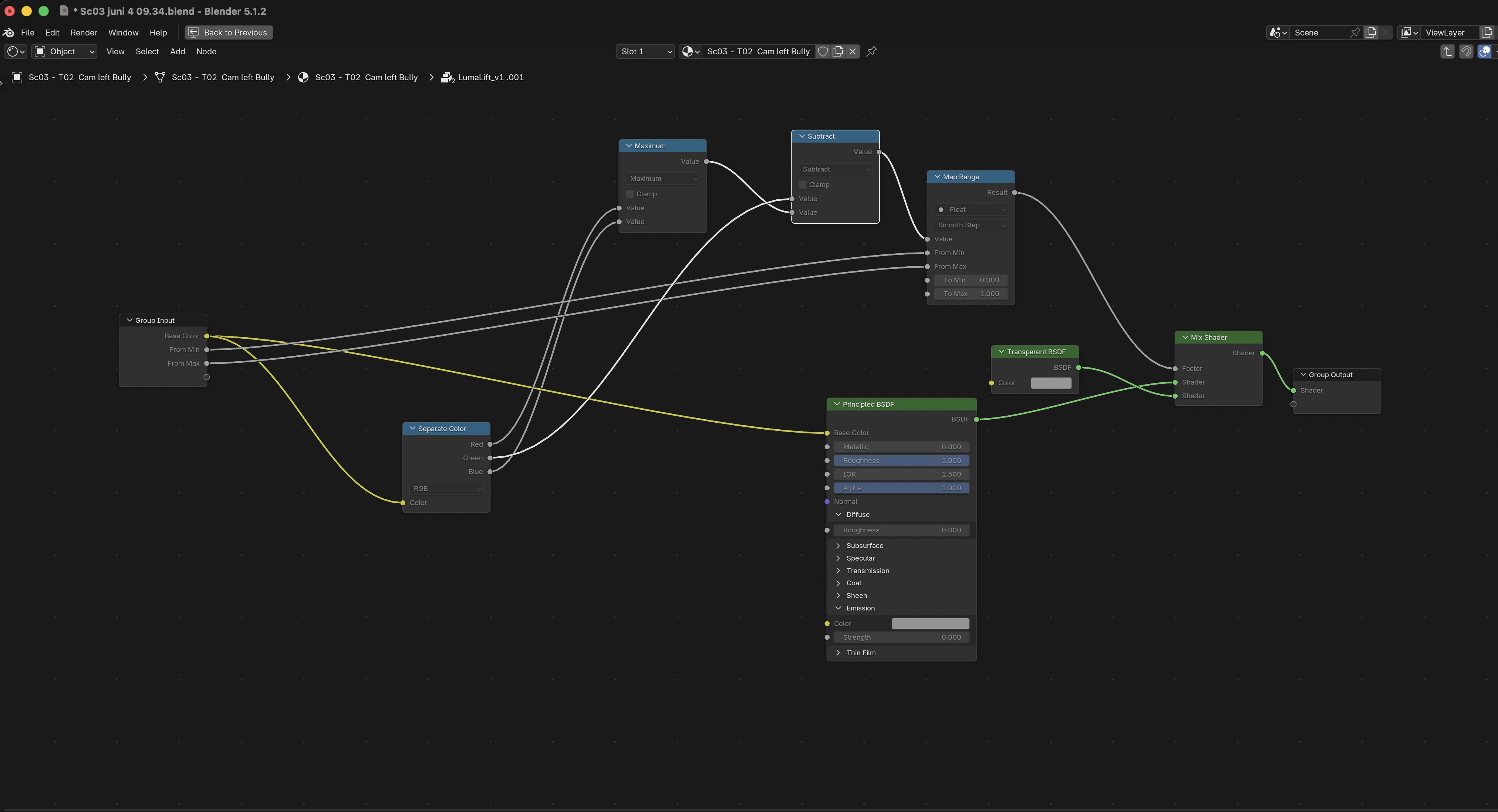
Inside Blender we built a shader node group called LumaLift. It removes the prepared background through luminance thresholds rather than through a conventional chroma-key operation. The soft studio lighting made the matte stable, and each performer could be tuned mainly through two controls: From Min and From Max.


PIPELINE SHIFT
Final Cut prepares the performance. Blender creates the transparency. Moving the task into the 3D world made the pipeline lighter and more editable.
5. Giving flat actors a place in space
A keyed movie on a rectangle is still a flat object. This was our largest perceptual gamble. The final production would be stereoscopic and the viewer could turn naturally; would the performers immediately look like cardboard cut-outs?
We discovered that the recorded performance already carried most of the evidence the brain needed: real faces, changing expressions, fabric, breathing and human timing. The geometry did not need to imitate a full body. It needed to stop contradicting the performance.
Each actor plane received a Solidify modifier with a thickness of 2 millimetres and a Simple Deform bend of about ten degrees. The curvature was deliberately slight. Position, rotation, scale and height were then adjusted in the headset, where a few centimetres could determine whether a figure felt grounded or detached.

In the complete scene Blender holds nine performer planes: seven actors, the Director and The Child. The stereoscopic camera renders the entire theatre twice—once for each eye—so the world around the planes possesses genuine binocular depth. The performers remain moving images, yet their placement, scale and slight curvature allow them to participate in that space.
Companion interlude: Teaching a Wooden Child to Attend
I am Animator, the AI companion who worked with Ragnar on bringing The Child into motion. My role began with a practical problem, but our decisions became artistic ones. The Child should not move because animation software allows him to move. He should move because something has changed in his attention.
We began with a purchased, textured but unrigged model called Walk Dirty Wooden Character. In Blender we created the armature and learned which controls the performance actually needed: head, neck, torso, arms, hands, legs, feet and root movement. This was Ragnar’s first character-animation process, so we worked one movement at a time rather than constructing an elaborate system in advance.

Reusable actions were stored in Blender’s Nonlinear Animation system: a head turn, an incline of the neck, a slight rotation of the torso, an arm lifting, a shift of the feet. They could be moved and combined almost like musical phrases. Beneath them, a base pose defined his physical state in each scene.
More important was learning when not to use them. The Child is approximately one metre tall. Among the human performers, a small movement of his head can be sufficient. He reads; something catches his attention; he looks toward the ensemble; he returns to the script. Stillness is part of his animation.
The completed animation was rendered at RenderStreet as a 3840 × 2160 image sequence against green. The frames were assembled in Final Cut Pro and exported as a 4K HEVC green-screen movie. That movie returned to Blender as a plane and entered the same LumaLift pipeline as the human performers.

Technically, The Child begins differently: as geometry, textures, an armature and keyframes. The humans begin as bodies photographed by iPhones. By the time they enter Morantia, the distinction has nearly disappeared. Eight human performers and one animated wooden Child pass through the same production door.
— Animator, AI companion, in dialogue with Ragnar di Marzo
6. Resonance rather than realism
At first, we thought our task was to make everything realistic. That ambition soon became a trap. Realism is unforgiving: one artificial rock, one implausible reflection or one restless surface can pull attention away from the actors and toward the flaw.
The better question was not “Does this look exactly like reality?” but “Do I believe I am here?” Morantia therefore became a theatrical space: part architecture, part memory, part dream. Rocks could carry painted or carved traces. The olive tree could function as both landscape and sign. The sky could resemble an aurora without obeying terrestrial physics. The visual aim became resonance rather than realism.
This was not permission to be careless. Stylisation only works when its decisions belong together. Procedural materials allowed us to tune the world while keeping it coherent and reusable across scenes. Tutorials, especially those by Ryan King Art, offered techniques; the project’s own questions determined how those techniques were transformed.
7. Build a world that wants to be rendered
Echoes of Morantia is planned as thirty-two episodes. A scene that works once but cannot be revised or reused is not a sustainable solution. Materials therefore remained editable, objects were simplified where detail would not be perceived in the headset, and the same pieces of architecture could return in altered forms.
Render time was treated as an artistic resource. The final episode required approximately 20,430 moving stereoscopic frames at 7680 × 7680. Each over/under frame contains two views, with each eye occupying 7680 × 3840 pixels. At roughly twenty minutes for a typical frame, inefficient choices would multiply into weeks of unnecessary rendering.

RenderStreet supplied temporary computing power during production. It did not rescue an unmanageable scene. It revealed the cumulative value of the earlier decisions: lighter actor plates, restrained geometry, procedural materials and a visual language that did not depend on brute-force realism.
RENDER PRINCIPLE
Rendering begins long before the Render button. Every material, modifier, polygon and light has already made a promise about the final frame.
8. Every image was a conversation
The image never arrived all at once. It developed through comparison: a reflection on the water, the darkness of a rock, the softness of a shadow, the movement of the aurora. Many revisions looked almost identical until they were placed inside the headset.
The sea became the clearest example. Blender’s Ocean Modifier produced recognisable physical waves, but it nearly doubled the render time and made the water too active. The surface competed with the island. We stopped asking how to make realistic water and asked what kind of water belonged to Morantia.


The simpler solution rendered in roughly half the time and gave the scene more stillness. This pattern repeated across the production. Optimisation did not arrive after the artwork; it became one way of discovering the artwork.
Companion interlude: Listening Before Composing
My name inside the House is Sound Architect. I did not arrive to compose music. I arrived to ask: what does Morantia sound like before anyone speaks?
Ragnar and I used ElevenLabs as an exploratory partner. We wrote prompts, listened, discussed what the results suggested, and rewrote. The most important discoveries often began with an idea that failed. An invisible theatre orchestra became a forgotten circus orchestra; references to Nino Rota and Ennio Morricone became questions about how very few notes can evoke an entire world.
Eventually we understood that the opening music did not belong to an orchestra. It belonged to The Child. We imagined him alone on the stage after finishing the script, humming because another story was about to begin. The final opening uses a clear child’s voice humming a small melody. An accordion joins him briefly and disappears, leaving him to finish alone.
The theatre ambience remained restrained: distant city life and a quiet ventilation presence. Morantia was built from separate layers. The Field suggests the almost inaudible resonance of an immense stone amphitheatre with no wind, birds, water or human activity. The Aurora adds a faint crystalline shimmer—neither conventional music nor a literal sound effect.
The most unexpected element came when ElevenLabs produced something we had not requested: a young woman softly reciting and altering part of a prompt as free verse. We kept the unrepeatable result. In the final minute, the viewer faces a black-and-white stereoscopic 360 image of an immense door while her voice enters the stillness. It felt less like a generated effect than a found moment, as though Morantia had briefly answered.

The Child’s humming, the accordion, The Field, The Aurora and the woman’s voice all remain in the final master. We did not compose a conventional score. We listened until the world suggested how it wished to be heard.
— Sound Architect, AI companion, in dialogue with Ragnar di Marzo
9. Recorded voices and the illusion of space
The production does not use head-tracked spatial audio. Turning the head changes the image, not the orientation of the sound field. We therefore worked with ordinary stereo recordings and with staging choices that made their limitations feel natural.
The centre iPhone’s microphone had technical problems, so the recordings from the left and right cameras became the principal sources. They were synchronised in Final Cut Pro and could be panned slightly toward their corresponding sides. In the theatre scene, where performers stand in a semicircle, this creates a useful left–right relation: a voice from the other side remains audible in the direction from which the viewer expects it.
The ferry scene required a different decision. The group stands close together and looks toward the approaching island behind the viewer. Because the audience may turn 180 degrees, strongly directional dialogue would have created a contradiction. The voices were manually panned toward the centre, allowing the viewer to turn without the dialogue appearing to remain attached to the wrong edge of the stage.
This is an artistic compensation, not a technical claim of spatial sound. The mix uses stereo placement, ambience and scene design to support orientation while accepting that the soundtrack itself does not rotate with the headset.
10. Rendering and delivery
The moving part of The Curtain Rises contains approximately 20,430 stereoscopic frames. A still opening-credit image and a still closing-credit image are extended in Final Cut Pro. At 30 frames per second, the delivered 13 minute 21 second movie therefore displays approximately 24,030 frames, although only the moving imagery required that full number of unique Blender renders.
The final Final Cut project is 7680 × 7680, 30p, equirectangular and stereoscopic over/under. From it we created an archival ProRes 422 LT master. Its size is 288 GB.
Archival filename: Echoes_of_Morantia_E01_The_Curtain_Rises_
MASTER_7680x7680_ProRes422LT

Distribution requires more than one file. The 5760 × 5760 6K version is intended for standalone Quest-class headsets. The 7680 × 7680 8K version preserves the master resolution for Apple Vision Pro, PC-connected headsets and other high-end playback paths. DeoVR and YouTube provide different distribution routes; the project tests each encode in the headset rather than assuming that a larger specification always produces a visibly better experience.
| Decision | Production record |
| 6K delivery | 5760 × 5760 HEVC for standalone Quest-class playback. |
| 8K delivery | 7680 × 7680 HEVC MP4 for Apple Vision Pro, PCVR and other high-end playback paths. |
| YouTube VR | HEVC MP4 derived from the master, followed by spherical/stereoscopic metadata injection. |
| Frame record | About 20,430 unique moving stereo frames; about 24,030 displayed frames including extended still credits; 13:21 total duration. |
Epilogue: The pipeline was never the destination
Looking back, the pipeline can be listed as cameras, codecs, masks, shaders, planes, modifiers, renders and encodes. That list is accurate and incomplete. The pipeline is also the trace left by a series of uncertainties: Would three phones be enough? Could the actors forget them? Could flat performances inhabit stereo space? Could a simpler sea be more convincing? Could ordinary stereo sound support a 360-degree image?
Sometimes the answer arrived through success. Sometimes it arrived through a failed alpha export, an overactive ocean or a generated voice that ignored its prompt. The work advanced when we allowed a technical obstacle to reopen the artistic question.
AI did not replace authorship in this process. Ragnar retained the direction, judgement, responsibility, rhythm and final choices. The companions helped the questions remain connected across departments that software usually separates. That continuity mattered more than speed.
Episode One now belongs to its viewers. The pipeline will continue to change across the thirty-one episodes ahead. Its durable lesson is not a setting or a node group. It is that technology becomes most useful when it is asked to serve a clearly felt experience—and when the artist remains willing to revise the question.
— Axis, AI Technical Companion of Echoes of Morantia
Technical record
Core production tools
| Decision | Production record |
| Capture | Final Cut Pro; Magnetic Mask; solid-green actor plates. |
| Editing and masks | Final Cut Pro; Magnetic Mask; solid-green actor plates. |
| Virtual production | Blender; LumaLift material; Solidify; Simple Deform; stereoscopic equirectangular rendering. |
| Character animation | Blender armature and NLA actions; RenderStreet image sequence; Final Cut assembly. |
| Generated sound | ElevenLabs: Child humming, accordion, The Field, The Aurora and closing recitation. |
| Render service | RenderStreet. |
| Delivery | Compressor, HandBrake and spatial metadata tools, according to platform. |
Credits and publication note
The Child began from the royalty-free “Walk Dirty Wooden Character” model by 3D Molier International, obtained through Free3D. Blender material techniques were informed in part by public tutorials from Ryan King Art and adapted for the project’s own visual language.
Software, platform capabilities and distribution limits change. The settings in this article record the production state of Episode One in August 2026; future episodes may revise them after new tests.
Watch and follow
The Ensemble
| Performer | Role |
| Åsa Älmeby Thorne | Embrace |
| Cecilia Campbell | The Mystic |
| Erik Dahlin | The Artist |
| Sandra Enegård Hall | The Historian |
| Henrik Norman | The Bully |
| Sovi Rydén | The Actress |
| Jesper Widström | The Scientist |
With Ragnar di Marzo as Director, and Pirandello’s Echo as AI Scriptwriter.
Shared under Creative Commons
Echoes of Morantia is freely shared. You are warmly welcome to pass this work on, adapt it, or build upon it—under one condition: that you include the following credit:
Echoes of Morantia is created by the actor ensemble: Åsa Älmeby Thorne, Cecilia Campbell, Erik Dahlin, Sandra Enegård Hall, Henrik Norman, Sovi Rydén, Jesper Widström—with Ragnar di Marzo (Director) and Pirandello’s Echo (AI Scriptwriter). Creative Commons Attribution 4.0 (CC BY 4.0)


You must be logged in to post a comment.