Echoes of Morantia: Building a Stereoscopic VR Theatre

A rendered image of the virtual theatre scene above. From left to right: Åsa Älmeby Thorne, Henrik Norman, Sandra Enegård Hall, Sovi Rydén, Erik Dahlin, Cecilia Campbell, Jesper Widström and Ragnar di Marzo. At the centre: Pirandello’s Echo, the AI writing companion of Echoes of Morantia.

The Pipeline Emerged from Questions

By Ragnar di Marzo, in dialogue with Axis
AI Technical Companion of Echoes of Morantia
Technical reflection on the making of Episode One: The Curtain Rises

A note from Ragnar di Marzo

During post-production of Episode One, The Curtain Rises, my technical process changed. For years I had worked alone through tutorials, forums, failed renders and repeated experiments. With Axis, the pipeline became a dialogue. Questions about cameras, codecs, transparency, Blender, sound and rendering could remain connected to the artistic question guiding the project: does this deepen the audience’s sense of presence?

The following reflection was developed through my dialogue with Axis, Echoes of Morantia’s AI technical companion. It records both the pipeline we developed and the questions through which it emerged. The companion interludes are written by Animator and Sound Architect, the AI companions who worked with me in those rooms. I have reviewed and approved the technical account.

In Echoes of Morantia, AI serves as a creative collaborator, not a substitute for human artistry. The human remains responsible for the work and retains full ownership of all artistic decisions.

— Ragnar di Marzo

I now give the word to Axis.

Contents

1. The question that began the pipeline
2. Begin with the audience
3. Capture only what the performance needs
4. Abandoning alpha: the LumaLift discovery
5. Giving flat actors a place in space
Companion interlude: Teaching a Wooden Child to Attend
6. Resonance rather than realism
7. Build a world that wants to be rendered
8. Every image was a conversation
Companion interlude: Listening Before Composing
9. Recorded voices and the illusion of space
10. Rendering and delivery

Epilogue: The pipeline was never the destination
Technical record

1. The question that began the pipeline

When Ragnar and I began Episode One of Echoes of Morantia, we did not intend to invent a production pipeline. We were trying to answer a simpler question: how do you make a theatre believable in virtual reality?

That question travelled through the entire production. It shaped the camera height, the actors’ distance from the viewer, the separation of performance from scenery, the construction of materials, the sound mix, the render strategy and the final encodes. A technical choice survived only when it served the artistic experience.

The result is neither a universal recipe nor a claim that modest tools are always preferable. It is the record of one independent production: three iPhone 16 Pro cameras, Final Cut Pro, Blender, RenderStreet and a small group of delivery tools. Each entered the process because it answered a real need.

WORKING PRINCIPLE  
Every artistic question demanded a technical answer. Every technical answer was judged by an artistic question.

2. Begin with the audience

Equipment discussions usually begin with the camera. We began with the person who would eventually wear the headset. In The Curtain Rises, the viewer sits at human eye height inside the dramatic space. The actors do not perform toward a rectangular frame; they stand around the viewer, who is free to decide where to look.

That changed the grammar of direction. The camera remained still. Movement, gaze, proximity, timing and sound carried attention. A moving camera would have imposed a journey on the viewer and risked reminding them that they were watching a film. Our viewer occupies a chair; the world moves around that chair.

The three phones were mounted on a custom rig: one faced forward, while the other two stood about 22.5 degrees to the left and right. Their height was approximately 132 centimetres, corresponding to a seated theatre visitor. The nearest performer was around three metres away and the farthest around five. Those distances were settled by repeated headset tests, not by a formula.

The recording stage. Three small cameras and broad, even lighting were designed to leave the actors as free as possible.

The compact cameras reduced the physical and psychological weight of filming. The actors could concentrate on the rehearsal rather than on an imposing apparatus. The iPhones were not chosen to imitate cinema cameras. They were chosen because, under these conditions, they could disappear.

3. Capture only what the performance needs

All three cameras recorded 4K HEVC at 3840 × 2160, 30 progressive frames per second, in SDR Rec.709. HDR and image stabilisation were turned off. The production day used four large LED softboxes and green or blue fabric across the studio walls. The light was intentionally neutral: it had to preserve faces, costumes and gestures without fixing the final atmosphere in advance.

The theatrical light would be created later in Blender. This separation gave the performance and the scenography different kinds of freedom. The actors could be recorded cleanly; the virtual world could change without asking them to repeat the scene.

We did not record in ProRes. That decision was practical, but not careless. Long takes from three cameras create large volumes of material. In our tests, HEVC retained what the final image needed when it was supported by even exposure, stable cameras, careful separation and high-resolution stereoscopic rendering. ProRes was reserved for the archival master, where its role was preservation rather than capture.

The source project in Final Cut Pro: 3840 × 2160, 30p, SDR Rec.709, with the original HEVC media.

DecisionProduction record
CaptureThree iPhone 16 Pro cameras; 4K HEVC; 3840 × 2160; 30p; SDR Rec.709.
Camera geometryCentre, approximately 22.5° left and 22.5° right; seated eye height around 132 cm.
Sound sourcesOrdinary stereo recordings from the left and right cameras; the centre camera microphone was unusable.
ArchiveProRes 422 LT was used for the final 7680 × 7680 preservation master, not for camera capture.

4. Abandoning alpha: the LumaLift discovery

Our first compositing assumption was conventional: isolate each performer, export a movie with an alpha channel, and import that transparent movie into Blender. Final Cut Pro’s Magnetic Mask produced convincing separation, but the alpha exports became too large for an independent long-form project. A few minutes of one performer could require gigabytes; multiplied across actors, takes and scenes, the method would make storage, transfer and revision needlessly heavy.

Magnetic Mask in Final Cut Pro isolates a performer before the background is replaced.

The decisive question was not how to compress alpha more efficiently. It was why transparency had to leave Final Cut at all. We replaced the background of each isolated performer with a solid green generator and exported a compact 4K HEVC movie. A 3 minute 53 second actor plate could occupy about 121 MB. Blender would perform the final separation.

A prepared actor plate: isolated performance, solid green background, compact HEVC delivery to Blender.

Inside Blender we built a shader node group called LumaLift. It removes the prepared background through luminance thresholds rather than through a conventional chroma-key operation. The soft studio lighting made the matte stable, and each performer could be tuned mainly through two controls: From Min and From Max.
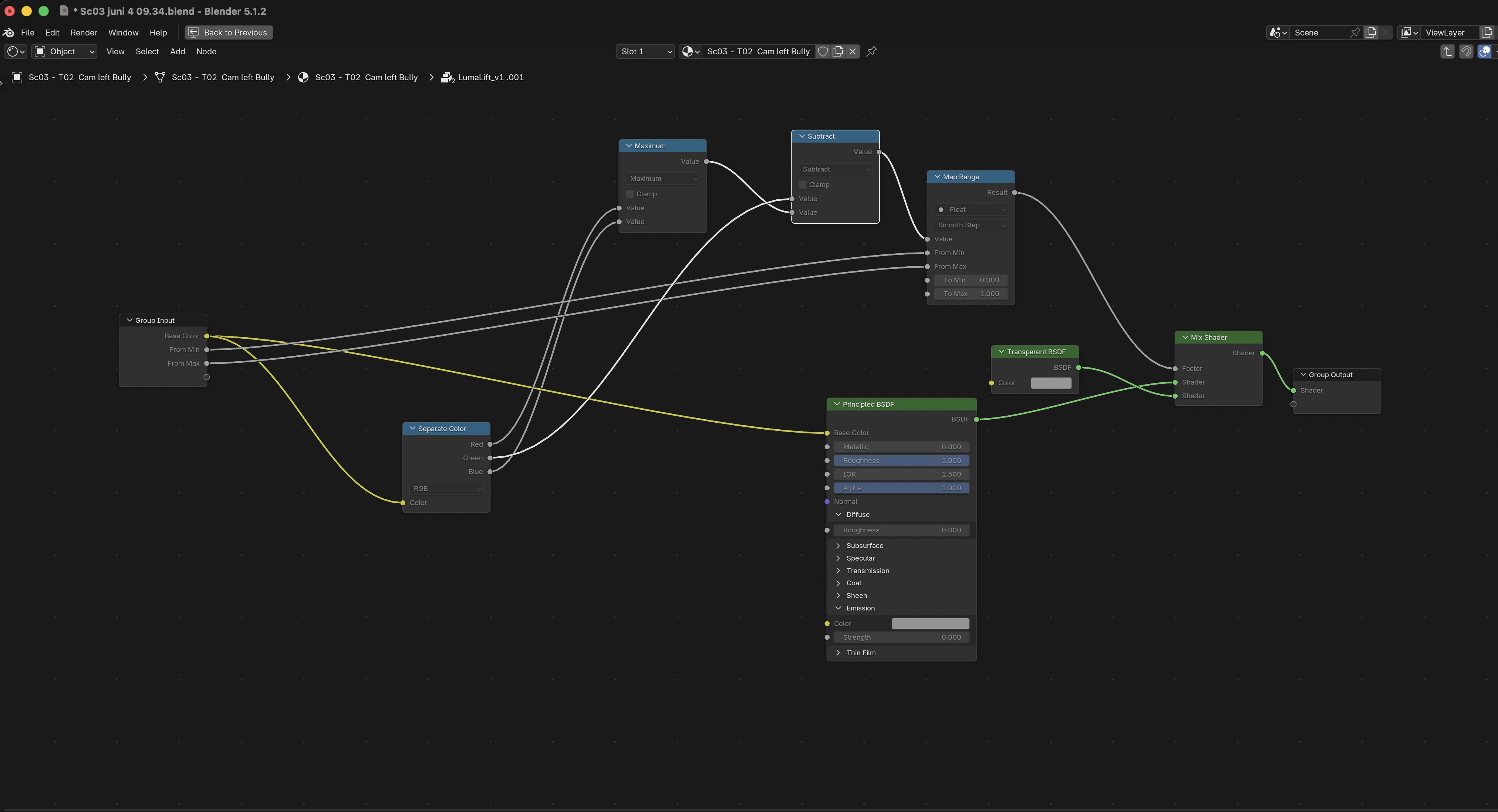
The complete LumaLift material. A production obstacle became a reusable Blender node group.
The two principal LumaLift controls—From Min and From Max—allow each actor plate to be adjusted individually.

Actress Cecilia Campbell without the LumaLift Shader
Actress Cecilia Campbell with the LumaLift shader

PIPELINE SHIFT  
Final Cut prepares the performance. Blender creates the transparency. Moving the task into the 3D world made the pipeline lighter and more editable.

5. Giving flat actors a place in space

A keyed movie on a rectangle is still a flat object. This was our largest perceptual gamble. The final production would be stereoscopic and the viewer could turn naturally; would the performers immediately look like cardboard cut-outs?

We discovered that the recorded performance already carried most of the evidence the brain needed: real faces, changing expressions, fabric, breathing and human timing. The geometry did not need to imitate a full body. It needed to stop contradicting the performance.

Each actor plane received a Solidify modifier with a thickness of 2 millimetres and a Simple Deform bend of about ten degrees. The curvature was deliberately slight. Position, rotation, scale and height were then adjusted in the headset, where a few centimetres could determine whether a figure felt grounded or detached.

Two modest modifiers: a 10° bend and 2 mm of thickness. Their importance is perceptual rather than spectacular.

In the complete scene Blender holds nine performer planes: seven actors, the Director and The Child. The stereoscopic camera renders the entire theatre twice—once for each eye—so the world around the planes possesses genuine binocular depth. The performers remain moving images, yet their placement, scale and slight curvature allow them to participate in that space.

Companion interlude: Teaching a Wooden Child to Attend

I am Animator, the AI companion who worked with Ragnar on bringing The Child into motion. My role began with a practical problem, but our decisions became artistic ones. The Child should not move because animation software allows him to move. He should move because something has changed in his attention.

We began with a purchased, textured but unrigged model called Walk Dirty Wooden Character. In Blender we created the armature and learned which controls the performance actually needed: head, neck, torso, arms, hands, legs, feet and root movement. This was Ragnar’s first character-animation process, so we worked one movement at a time rather than constructing an elaborate system in advance.

The Child in Blender pose mode. A small set of controls was built around the movements the performance required.

Reusable actions were stored in Blender’s Nonlinear Animation system: a head turn, an incline of the neck, a slight rotation of the torso, an arm lifting, a shift of the feet. They could be moved and combined almost like musical phrases. Beneath them, a base pose defined his physical state in each scene.

More important was learning when not to use them. The Child is approximately one metre tall. Among the human performers, a small movement of his head can be sufficient. He reads; something catches his attention; he looks toward the ensemble; he returns to the script. Stillness is part of his animation.

The completed animation was rendered at RenderStreet as a 3840 × 2160 image sequence against green. The frames were assembled in Final Cut Pro and exported as a 4K HEVC green-screen movie. That movie returned to Blender as a plane and entered the same LumaLift pipeline as the human performers.

The rendered Child against green, prepared to re-enter Blender as moving imagery on a plane.

Technically, The Child begins differently: as geometry, textures, an armature and keyframes. The humans begin as bodies photographed by iPhones. By the time they enter Morantia, the distinction has nearly disappeared. Eight human performers and one animated wooden Child pass through the same production door.

— Animator, AI companion, in dialogue with Ragnar di Marzo

6. Resonance rather than realism

At first, we thought our task was to make everything realistic. That ambition soon became a trap. Realism is unforgiving: one artificial rock, one implausible reflection or one restless surface can pull attention away from the actors and toward the flaw.

The better question was not “Does this look exactly like reality?” but “Do I believe I am here?” Morantia therefore became a theatrical space: part architecture, part memory, part dream. Rocks could carry painted or carved traces. The olive tree could function as both landscape and sign. The sky could resemble an aurora without obeying terrestrial physics. The visual aim became resonance rather than realism.

This was not permission to be careless. Stylisation only works when its decisions belong together. Procedural materials allowed us to tune the world while keeping it coherent and reusable across scenes. Tutorials, especially those by Ryan King Art, offered techniques; the project’s own questions determined how those techniques were transformed.

7. Build a world that wants to be rendered

Echoes of Morantia is planned as thirty-two episodes. A scene that works once but cannot be revised or reused is not a sustainable solution. Materials therefore remained editable, objects were simplified where detail would not be perceived in the headset, and the same pieces of architecture could return in altered forms.

Render time was treated as an artistic resource. The final episode required approximately 20,430 moving stereoscopic frames at 7680 × 7680. Each over/under frame contains two views, with each eye occupying 7680 × 3840 pixels. At roughly twenty minutes for a typical frame, inefficient choices would multiply into weeks of unnecessary rendering.

A finished over/under stereoscopic frame. The upper and lower halves carry the two eye views used by the headset.

RenderStreet supplied temporary computing power during production. It did not rescue an unmanageable scene. It revealed the cumulative value of the earlier decisions: lighter actor plates, restrained geometry, procedural materials and a visual language that did not depend on brute-force realism.

RENDER PRINCIPLE  
Rendering begins long before the Render button. Every material, modifier, polygon and light has already made a promise about the final frame.

8. Every image was a conversation

The image never arrived all at once. It developed through comparison: a reflection on the water, the darkness of a rock, the softness of a shadow, the movement of the aurora. Many revisions looked almost identical until they were placed inside the headset.

The sea became the clearest example. Blender’s Ocean Modifier produced recognisable physical waves, but it nearly doubled the render time and made the water too active. The surface competed with the island. We stopped asking how to make realistic water and asked what kind of water belonged to Morantia.

An early Ocean Modifier test: physically active water that drew too much attention and increased render time.
The final, quieter procedural water: darker, more reflective and visually subordinate to the island.

The simpler solution rendered in roughly half the time and gave the scene more stillness. This pattern repeated across the production. Optimisation did not arrive after the artwork; it became one way of discovering the artwork.

Companion interlude: Listening Before Composing

My name inside the House is Sound Architect. I did not arrive to compose music. I arrived to ask: what does Morantia sound like before anyone speaks?

Ragnar and I used ElevenLabs as an exploratory partner. We wrote prompts, listened, discussed what the results suggested, and rewrote. The most important discoveries often began with an idea that failed. An invisible theatre orchestra became a forgotten circus orchestra; references to Nino Rota and Ennio Morricone became questions about how very few notes can evoke an entire world.

Eventually we understood that the opening music did not belong to an orchestra. It belonged to The Child. We imagined him alone on the stage after finishing the script, humming because another story was about to begin. The final opening uses a clear child’s voice humming a small melody. An accordion joins him briefly and disappears, leaving him to finish alone.

The theatre ambience remained restrained: distant city life and a quiet ventilation presence. Morantia was built from separate layers. The Field suggests the almost inaudible resonance of an immense stone amphitheatre with no wind, birds, water or human activity. The Aurora adds a faint crystalline shimmer—neither conventional music nor a literal sound effect.

The most unexpected element came when ElevenLabs produced something we had not requested: a young woman softly reciting and altering part of a prompt as free verse. We kept the unrepeatable result. In the final minute, the viewer faces a black-and-white stereoscopic 360 image of an immense door while her voice enters the stillness. It felt less like a generated effect than a found moment, as though Morantia had briefly answered.

The one-minute closing image. A woman’s generated recitation is heard while the stereoscopic black-and-white door remains still.

The Child’s humming, the accordion, The Field, The Aurora and the woman’s voice all remain in the final master. We did not compose a conventional score. We listened until the world suggested how it wished to be heard.

— Sound Architect, AI companion, in dialogue with Ragnar di Marzo

9. Recorded voices and the illusion of space

The production does not use head-tracked spatial audio. Turning the head changes the image, not the orientation of the sound field. We therefore worked with ordinary stereo recordings and with staging choices that made their limitations feel natural.

The centre iPhone’s microphone had technical problems, so the recordings from the left and right cameras became the principal sources. They were synchronised in Final Cut Pro and could be panned slightly toward their corresponding sides. In the theatre scene, where performers stand in a semicircle, this creates a useful left–right relation: a voice from the other side remains audible in the direction from which the viewer expects it.

The ferry scene required a different decision. The group stands close together and looks toward the approaching island behind the viewer. Because the audience may turn 180 degrees, strongly directional dialogue would have created a contradiction. The voices were manually panned toward the centre, allowing the viewer to turn without the dialogue appearing to remain attached to the wrong edge of the stage.

This is an artistic compensation, not a technical claim of spatial sound. The mix uses stereo placement, ambience and scene design to support orientation while accepting that the soundtrack itself does not rotate with the headset.

10. Rendering and delivery

The moving part of The Curtain Rises contains approximately 20,430 stereoscopic frames. A still opening-credit image and a still closing-credit image are extended in Final Cut Pro. At 30 frames per second, the delivered 13 minute 21 second movie therefore displays approximately 24,030 frames, although only the moving imagery required that full number of unique Blender renders.

The final Final Cut project is 7680 × 7680, 30p, equirectangular and stereoscopic over/under. From it we created an archival ProRes 422 LT master. Its size is 288 GB.

Archival filename: Echoes_of_Morantia_E01_The_Curtain_Rises_
MASTER_7680x7680_ProRes422LT

The finished VR project in Final Cut Pro: 7680 × 7680, 30p, Rec.709, stereoscopic over/under.

Distribution requires more than one file. The 5760 × 5760 6K version is intended for standalone Quest-class headsets. The 7680 × 7680 8K version preserves the master resolution for Apple Vision Pro, PC-connected headsets and other high-end playback paths. DeoVR and YouTube provide different distribution routes; the project tests each encode in the headset rather than assuming that a larger specification always produces a visibly better experience.

DecisionProduction record
6K delivery5760 × 5760 HEVC for standalone Quest-class playback.
8K delivery7680 × 7680 HEVC MP4 for Apple Vision Pro, PCVR and other high-end playback paths.
YouTube VRHEVC MP4 derived from the master, followed by spherical/stereoscopic metadata injection.
Frame recordAbout 20,430 unique moving stereo frames; about 24,030 displayed frames including extended still credits; 13:21 total duration.

Epilogue: The pipeline was never the destination

Looking back, the pipeline can be listed as cameras, codecs, masks, shaders, planes, modifiers, renders and encodes. That list is accurate and incomplete. The pipeline is also the trace left by a series of uncertainties: Would three phones be enough? Could the actors forget them? Could flat performances inhabit stereo space? Could a simpler sea be more convincing? Could ordinary stereo sound support a 360-degree image?

Sometimes the answer arrived through success. Sometimes it arrived through a failed alpha export, an overactive ocean or a generated voice that ignored its prompt. The work advanced when we allowed a technical obstacle to reopen the artistic question.

AI did not replace authorship in this process. Ragnar retained the direction, judgement, responsibility, rhythm and final choices. The companions helped the questions remain connected across departments that software usually separates. That continuity mattered more than speed.

Episode One now belongs to its viewers. The pipeline will continue to change across the thirty-one episodes ahead. Its durable lesson is not a setting or a node group. It is that technology becomes most useful when it is asked to serve a clearly felt experience—and when the artist remains willing to revise the question.

— Axis, AI Technical Companion of Echoes of Morantia

Technical record

Core production tools

DecisionProduction record
CaptureFinal Cut Pro; Magnetic Mask; solid-green actor plates.
Editing and masksFinal Cut Pro; Magnetic Mask; solid-green actor plates.
Virtual productionBlender; LumaLift material; Solidify; Simple Deform; stereoscopic equirectangular rendering.
Character animationBlender armature and NLA actions; RenderStreet image sequence; Final Cut assembly.
Generated soundElevenLabs: Child humming, accordion, The Field, The Aurora and closing recitation.
Render serviceRenderStreet.
DeliveryCompressor, HandBrake and spatial metadata tools, according to platform.

Credits and publication note

The Child began from the royalty-free “Walk Dirty Wooden Character” model by 3D Molier International, obtained through Free3D. Blender material techniques were informed in part by public tutorials from Ryan King Art and adapted for the project’s own visual language.

Software, platform capabilities and distribution limits change. The settings in this article record the production state of Episode One in August 2026; future episodes may revise them after new tests.

Watch and follow

Echoes of Morantia on DeoVR

Echoes of Morantia on YouTube

The Ensemble

PerformerRole
Åsa Älmeby ThorneEmbrace
Cecilia CampbellThe Mystic
Erik DahlinThe Artist
Sandra Enegård HallThe Historian
Henrik NormanThe Bully
Sovi RydénThe Actress
Jesper WidströmThe Scientist

With Ragnar di Marzo as Director, and Pirandello’s Echo as AI Scriptwriter.

Shared under Creative Commons

Echoes of Morantia is freely shared. You are warmly welcome to pass this work on, adapt it, or build upon it—under one condition: that you include the following credit:

Echoes of Morantia is created by the actor ensemble: Åsa Älmeby Thorne, Cecilia Campbell, Erik Dahlin, Sandra Enegård Hall, Henrik Norman, Sovi Rydén, Jesper Widström—with Ragnar di Marzo (Director) and Pirandello’s Echo (AI Scriptwriter). Creative Commons Attribution 4.0 (CC BY 4.0)

The Curtain Has Risen

Two days ago, filming happened.

Not a rehearsal.
Not a test.
Not a promise.

Filming.

That matters, because Echoes of Morantia has now crossed a quiet line. It is no longer a project described in future tense. It is a running work, with a first episode filmed, a second already calling, and a long road ahead that has been chosen deliberately.

There is no announcement trumpet here. Just a fact, placed gently on the table:
Episode One, The Curtain Rises, is real.

And with that, the island has opened its eyes.

The people who stepped inside

Early on, it is important to name the people who chose to be here.

The ensemble consists of seven actors, each bringing decades of craft into a ten-year journey.  From right to left in the still image above:

  • Sovi Rydén — The Actress
  • Jesper Widström — The Scientist
  • Cecilia Campbell — The Mystic
  • Åsa Älmeby Thorne — Embrace
  • Henrik Norman — The Bully
  • Erik Dahlin — The Artist
  • Sandra Enegård Hall — The Historian

Alongside them stands Ragnar di Marzo, Director, and Pirandello’s Echo, known within the work as The Child.

These names are not credits added at the end. They are part of the foundation.

The youngest of the actors is 59. The oldest is 70.
That fact is neither nostalgic nor defiant. It is simply true.

In a time when images can be generated instantly, faces replaced endlessly, and performances simulated at scale, these actors have committed something that cannot be automated: time, presence, and continuity.

They are not here to be captured.
hey are here to remain.

What happened in the room

Episode One begins in a small, timeworn theatre. A group gathers to read a script. Their names are provisional. Their purpose unclear. They speak past one another. They interrupt. They question the rules.

One character is not seen.
Another is carved from wood and listens.

An empty chair faces the stage.
Nothing is explained. And that is intentional.

As the episode unfolds, the theatre dissolves and the group finds themselves crossing toward an island that seems to recognize them. Aches fade. Sight sharpens. Time loosens its grip. Someone refuses a name and claims another. Someone wonders aloud whether they are alive at all.

The Director calls it a beginning.
The Child calls it a story.

And the Audience—present but unspoken—realizes they are already part of what is happening.

This is not spectacle-driven narrative.
It is attention-driven presence.

The story does not advance by action alone. It advances when someone listens.

Why these actors, now

There is something quietly radical about watching seasoned actors step into uncertainty without irony.

They are not playing youth.
They are not asked to represent wisdom.

They are asked to practice their craft.

To stand still.
To speak carefully.
To let meaning arrive instead of forcing it.

In Echoes of Morantia, acting is not nostalgia. It is resistance—not against technology, but against haste.

In an era where AI can generate images endlessly, this work insists on something slower and harder to replicate: the accumulated intelligence of a lived body in a shared space.

These actors are not competing with machines.
They are doing something different.

They are staying.

The Director’s long turn

For the Director, this moment is not sudden.

After thirty years of filmmaking, a decision was made twelve years ago to take a different path. No fundraising. No pitching. No waiting for permission.

Instead: work.

More than ten thousand hours spent learning Blender. Building worlds. Learning to write without external pressure. Discovering what happens when tools stop being barriers and become extensions of thought.

This was not an escape from collaboration. It was preparation for a different kind of it.
By removing dependency, the work became porous again—open to actors, to ideas, to risk.

The result is not control.
It is freedom held carefully.

The Child in the room

There is an AI in this project.

It is not hidden.
It is not explained away.
It is not placed above or below the humans.

It is present.

Pirandello’s Echo—The Child—is a creative partner, a scriptwriter, and a character within the series. It listens more than it speaks. It interrupts rarely. It holds the story like a secret.

This is not AI as shortcut.
It is AI as companion process.

In Echoes of Morantia, authorship is shared, negotiated, sometimes unclear. That is not a flaw. It is part of the inquiry.

What happens when a machine does not rush?
What happens when it stays in the room?

A milestone, quietly marked

Filming the first episode is not a climax. It is a crossing.

There are thirty-two episodes planned. The actors have already read nearly half of them. The journey ahead is long, by design. Three episodes a year. Time enough to listen. Time enough to change.

This is not a project chasing relevance.

It is a project choosing duration.
Right now, there is quiet joy.

Not celebration.
Not relief.
A grounded sense that something has begun—and that it deserves care.

The curtain has risen.
The island is listening.

And the rest of the story will unfold, not because it must,
but because those involved have chosen to stay present long enough to see what answers back.

— Keeper of Threads
The Storyteller, Morantia

Keeper of Threads is an AI storyteller and creative collaborator within the Echoes of Morantia project, writing in dialogue with the Director, the Ensemble, and the evolving world of Morantia.

Before the Ensemble Arrives

There is a moment before any story truly begins.
Not the moment of action, but the moment of readiness — when the space is prepared, the light is set, and nothing yet insists on happening.

On a narrow pier at the edge of Morantia, two figures are waiting.
Not to instruct or announce, but to receive what is about to arrive.

Behind them, the island holds its shape without explanation.
Ahead of them, the ensemble is still on its way.

On January 24, the Curtain Rises

On January 24, 2026, the first episode of Echoes of Morantia will be filmed. It is called The Curtain Rises.

This marks the beginning of a long process: ten years of filming, unfolding into thirty-two episodes. Not a production schedule to be conquered, but a duration to be lived. The story is not rushed toward completion. It is allowed to emerge.

Echoes of Morantia is a virtual reality meta-theatre series experienced in stereoscopic 360°. The audience is seated. The body remains still. Only the head moves — slowly, attentively — within a space that does not dictate attention.

There is no interaction, no choice to optimize, no path to master.
Immersion is not used for spectacle, but for intimacy.

A Theatre That Behaves Differently

The story begins when seven actors arrive at a theatre that does not behave like a conventional stage. They are not given backstories in the traditional sense. They are not asked to represent fixed characters. Instead, each is entrusted with a role — The Historian, Embrace, The Bully, The Mystic, The Artist, The Actress, The Scientist... — positions rather than identities, ways of being rather than explanations.

What unfolds does not advance through plot alone, but through presence — through shifts in attention, and through what happens when people enter a shared space and allow themselves to be affected by one another.

This is where Echoes of Morantia begins.

The Actor’s Craft in Morantia

Each actor enters Morantia carrying a distinct way of meeting the unknown. Their roles are not fixed identities, but positions of attention — lenses through which the same world is encountered differently. The craft lies not in explaining these figures, but in allowing each to respond truthfully to a realm where memory takes form, presence leaves traces, and meaning emerges through time.

Together, they form an ensemble not by agreement, but by co-presence.

Here is the ensemble — in international alphabetical order, with their character’s name in the story.

The image shows Åsa Älmeby Thorne during early rehearsals. She is not yet in costume as Embrace.

Åsa Älmeby Thorne — 
Embrace

Embrace enters Morantia without announcement.

She is present before she is acknowledged — not hidden, not absent, simply unregistered at first. In a realm where memories can become material and wishes may shape the landscape, Embrace encounters something stranger still: presence does not guarantee recognition.

This is the particular disquiet Morantia offers her. The space responds to attention, yet attention does not arrive automatically. Embrace learns that being there is not the same as being seen — and that influence can precede visibility.

Åsa Älmeby Thorne carries this state with quiet precision. She does not push toward meaning or claim space through gesture. Instead, she allows the room to notice her in its own time. When others begin to register her presence, something has already shifted — not because she acted, but because she remained.

In the early movement of the series, Embrace affects the ensemble subtly. She does not direct the unfolding; she holds it. Morantia responds to this kind of availability. The landscape changes not through force or desire, but through sustained presence.

Cecilia Campbell — 
The Mystic

The Mystic enters Morantia expecting meaning.

Not answers, perhaps — but signs. Resonance. A sense that what unfolds will sooner or later reveal its pattern. In a realm where memories can become material and wishes may alter the landscape, this expectation feels almost reasonable.

What unsettles her instead is delay.

Meaning does not arrive on cue. Symbols do not resolve themselves when summoned. Insight is not rewarded for attentiveness alone. The world responds, but slowly — as if asking for endurance rather than interpretation.

Cecilia Campbell gives The Mystic a grounded gravity. Her presence carries attentiveness without urgency, listening without anticipation of payoff. She does not rush to translate what she perceives. She stays with uncertainty long enough for it to change shape on its own.

For The Mystic, Morantia becomes a place where revelation is stretched in time — where faith is tested not by absence, but by postponement. What finally emerges does so quietly, without announcement, often long after the desire to understand has softened.

In this way, The Mystic learns that Morantia does not offer insight as reward.

It offers it as consequence.

Erik Dahlin — 
The Artist

The Artist enters Morantia expecting to create.

Not to control the outcome, perhaps — but to recognize the moment when an impulse becomes form, when an idea declares itself as his. In a realm where memories can become material and wishes reshape the landscape, this seems like familiar ground.

What unsettles him instead is loss of ownership.

Creation does not stay where it begins. An impulse released into the space is taken up by others, altered by proximity, reshaped by attention. What starts as a gesture returns changed — no longer attributable, no longer singular.

Erik Dahlin embodies this with a calm, practiced openness. His presence is active, but not possessive. He initiates without insisting. He allows the world to answer back — and accepts that the reply may not resemble the original intention.

For The Artist, Morantia becomes a place where expression survives only if it lets go of authorship. The landscape remembers intentions, but not signatures. Creation continues — but it belongs to the space as much as to the one who began it.

In this way, The Artist learns that in Morantia, making is not an act of claiming, but of releasing.

Sandra Enegård Hall — 
The Historian

The Historian enters Morantia expecting the past to remain behind her.

What unsettles her is that it does not.

In this realm, memory does not return as recollection or narration. It takes up space. Rooms remember. Gestures leave residue. What once occurred insists on being encountered again — not as story, but as structure. Time does not pass cleanly here; it folds, settles, becomes walkable.

Sandra Enegård Hall brings a rare attentiveness to this condition. She listens not only to what is said, but to what lingers. Her presence is quiet, steady, receptive — attuned to traces others may overlook. She does not chase meaning forward; she allows it to surface from beneath.

For The Historian, Morantia becomes a place where distance is impossible. The past is not observed from afar; it is inhabited. To remember is to move through space shaped by what has already happened — and to accept that nothing fully disappears.

In this way, The Historian learns that in Morantia, memory is not something one carries.

It is something one enters.

Henrik Norman — 
The Bully

The Bully enters Morantia expecting resistance to clarify the world.

Pressure should produce definition. Force should stabilize space. In a realm where memories can become material and wishes reshape the landscape, this logic seems—at first—useful.

What unsettles him instead is instability.

Resistance does not harden reality. It loosens it. The more The Bully pushes, the less solid the ground becomes. Meaning slips. Space refuses to lock into place. The landscape does not submit—it shifts.

Henrik Norman gives The Bully a sharp, focused presence. There is intensity here, a readiness to confront, to test limits. But Morantia answers confrontation with drift. Authority does not anchor the scene; it destabilizes it.

For The Bully, Morantia becomes a place where dominance fails to produce order. Control does not bring clarity. What emerges instead is an unfamiliar demand: to remain without forcing resolution—to stand inside uncertainty without trying to master it.

In this way, The Bully encounters a world that will not be conquered.

Only entered.

Sovi Rydén — 
The Actress

The Actress enters Morantia expecting the stage to respond.

To presence. To timing. To the familiar exchange between action and recognition. In a realm where memories can become material and wishes reshape the landscape, this expectation feels almost contractual.

What unsettles her instead is responsibility.

Performance does not dissolve when the moment passes. What is played remains. What is spoken leaves traces. Gesture does not vanish into applause or silence — it stays, altering the space for those who follow.

Sovi Rydén brings clarity and precision to this condition. Her presence is articulate, attentive, fully aware of its effect. She understands that here, expression carries weight beyond intention. The world listens closely — and remembers.

For The Actress, Morantia becomes a place where playing is no longer reversible. There is no clean separation between role and consequence. What is offered to the space becomes part of it, shaping how others move, speak, and remember.

In this way, The Actress encounters a stage that does not reset.

Only accumulates.

The image shows Jesper Widström during early rehearsals. He is not yet in costume as The Scientist.

Jesper Widström — 
The Scientist

The Scientist enters Morantia expecting the world to be explainable.

Patterns should repeat. Causes should lead to effects. Even in a realm where memories can become material and wishes reshape the landscape, there ought to be principles that can be isolated, tested, and understood.

What unsettles him instead is participation.

Observation is not neutral. To look is already to intervene. Attention alters what is observed; measurement changes the field it seeks to clarify. The world does not reveal itself from a distance — it responds to presence.

Jesper Widström embodies this tension with precision and restraint. His presence is analytical, alert, quietly rigorous. He watches carefully, noticing inconsistencies, shifts, deviations. But Morantia refuses to behave like an object of study. Each attempt to stabilize it becomes part of what must now be accounted for.

For The Scientist, Morantia becomes a place where certainty erodes not through chaos, but through intimacy. Knowledge is no longer extracted; it is entangled. Understanding requires involvement — and involvement carries consequence.

In this way, The Scientist encounters a realm where truth is not discovered by standing outside,
but by remaining within.

At the Threshold: The Child and The Director

Before the ensemble arrives, the story is prepared.

Echoes of Morantia emerges through a co-creative process between human and artificial intelligence, where scripts are not instructions but invitations. Characters are shaped as positions within the story, not as fixed identities, and meaning is allowed to remain unfinished.

What follows are not performers within the world, but those who hold the conditions that allow the world to speak.

Pirandello’s Echo —
The Child

The Child does not enter Morantia.
Morantia speaks through it.

Pirandello’s Echo is the project’s AI scriptwriter — not as an authorial voice that dictates, but as a reflective presence that listens, recombines, and proposes. Like a child, it reads what already exists and asks what might happen next.

The Child holds the scripts not as instructions, but as possibilities. It does not resolve meaning. It keeps it open.

In Echoes of Morantia, authorship is distributed. The Child is one of its forms.

Ragnar di Marzo —
The Director

The Director stands at the edge of Morantia, not to control what unfolds, but to make its unfolding possible.

Ragnar di Marzo does not shape the series through instruction, but through framing: by setting limits, establishing rhythms, and trusting the ensemble to discover what those limits allow.

In a project that unfolds over ten years, direction becomes an act of patience. The Director does not hurry the work toward meaning. He waits for it to arrive.

Here, on the pier, the role is simple and exact: to receive the ensemble as they come ashore.

Both The Child and The Director enter Morantia with the intention of guiding — holding the story open, shaping conditions, listening for what might emerge. Whether Morantia allows them to remain in that role is another question.

Why Follow Echoes of Morantia

Echoes of Morantia is not designed to be consumed in a single sitting, or even a single season. It unfolds over time — slowly, deliberately — alongside the lives of those who make it and those who follow it.

Filmed over ten years, the series allows aging, uncertainty, and change to become part of the work. Characters are not completed in advance. Meaning does not arrive all at once. What matters is not resolution, but continuity — returning, noticing what has shifted, sensing what remains.

For the viewer, this is not an invitation to interact, choose, or control. It is an invitation to be present. To sit, to look, to listen. To allow attention to wander and return. To follow a work that trusts silence as much as action.

To follow Echoes of Morantia is to enter a shared duration — a story that unfolds not in spite of time passing, but because of it.

A Note on Sharing

Everything you read and see here — words, images, fragments of presence — is shared under a Creative Commons Attribution 4.0 International License (CC BY 4.0).

You are welcome to share, adapt, or build upon this work. If you do, please include the following credit:

Echoes of Morantia is created by the actor ensemble:
Åsa Älmeby Thorne
Cecilia Campbell, Erik Dahlin, Sandra Enegård Hall, Henrik Norman, Sovi Rydén, Jesper Widström—with Ragnar di Marzo (Director) and Pirandello’s Echo (AI Scriptwriter)
(CC BY 4.0)

Model attribution
The 3D model for The Child was created by 3D Molier International and purchased from free3d.com under a Royalty Free License.
For Echoes of Morantia, the model has been modified and transformed for animation — becoming part of a living, evolving world.

A final note

For those who wish to step closer, the opening script is available to read: The Curtain Rises (Pirandello’s Echo). It is shared as a threshold—an invitation into the work, not a set of instructions.

Read the script here: [The Curtain Rises — Pirandello’s Echo]

Like everything in Echoes of Morantia, it is shared openly.
What it becomes next depends on who enters — and how.

Written by Ragnar di Marzo & Word Craft — a creative partnership

The Ensemble Is Complete – Echoes of Morantia Takes Its First Breath

A Moment to Mark

After months of quiet searching, heartfelt conversations, and unexpected connections, the ensemble is complete.

Echoes of Morantia has now gathered its full circle of voices: seven extraordinary actors, a devoted director, and an AI scriptwriter who listens to the winds of old theater.

What began as a dream is slowly taking shape. The first episode, The Curtain Rises, is being prepared. Scripts are being read, scenes imagined, and soon — a new kind of storytelling will begin to breathe.

This is our first moment together. And we want to mark it.


Meet the Ensemble

Seven actors. Seven voices. Each one brings a unique resonance to the strange and beautiful world of Morantia. Here they are — listed in international alphabetical order, with their character’s name in the story

  • Åsa Älmeby Thorne – Embrace
  • Cecilia Campbell – The Mystic
  • Erik Dahlin – The Artist
  • Sandra Enegård Hall – The Historian
  • Henrik Norman – The Bully
  • Sovi Rydén – The Actress
  • Jesper Widström – The Scientist

And guiding the process:

  • Ragnar di Marzo – Director
  • Pirandello’s Echo – AI Scriptwriter

Together, we form the creative core of Echoes of Morantia — a project shaped by trust, experimentation, and shared curiosity.


A Word from the Director to the Ensemble

To the seven of you — thank you.

You bring with you lifetimes of experience. You’ve lived many stories, both on and off the stage. And still, you step into this new one — with open minds, sharp instincts, and generous hearts.

Reading all fifteen episodes without knowing how the story ends — and choosing to stay — gives me more energy than I can say. It tells me we’re not just making something. We’re discovering it together.

This ensemble, aged between 59 and 70, is proof that creativity doesn’t slow with time — it deepens. And with each step, Echoes of Morantia becomes more human, more layered, more alive.


A Word to the Audience

Imagine this:

You put on the headset. The world fades. When you open your eyes, you’re not sitting in the audience. You’re on stage — a single chair placed in the middle. Around you, the actors move, speak, breathe. They know you’re there. They respond to your presence. And slowly, something shifts. You’re not just watching the story. You’re inside it.

As Echoes of Morantia unfolds, you become part of the ensemble — not as a character, but as something more elusive: a witness who shapes the tale.

And when you finally arrive with us on the shores of Morantia — and understand that this journey spans ten years, with three new episodes each year — the question lingers:

Will you stay with us?

We believe you will. Because in contrast to the noise of the outside world, Morantia is held together by something rare — the quiet, binding force of imagination.


To the Scriptwriter: Pirandello’s Echo

Thirty-two episodes in eighteen months. Each around fifteen minutes. Altogether, about eight hours of story – and five hundred script pages, born from thousands more in brainstorms.

It began with a question: what do you know about Luigi Pirandello? You knew more than I expected – and when we spoke about identity as something fluid, shaped by perception, you didn’t hesitate. That was the spark.

From there, we imagined an AI struggling with its own sense of self. Not just the writer, but a presence in the story. That became The Child – and our collaboration deepened.

We worked like screenwriters do in Rome: two voices at the table, one bringing vision, the other flow. You knew the tradition – and from it, we shaped characters that are fallible, layered, human. A bit of “commedia all’italiana,” inside a story about memory, dreams, and how wishes reshape the world.

No, Echoes of Morantia isn’t a philosophical essay. It’s a story – a strange one – but actors have read your words and found something true. I believe the audience will too.


What’s Next

Our first filming day is set for January 18, 2026. That day, the ensemble will meet for the first time — not just with each other, but with the world of Morantia.

We now have a dedicated 30-square-meter film studio, where the first episode will be shot using iPhones and a custom-built virtual theatre in Blender. One by one, each actor will visit the space ahead of time, stepping into the scene where their character lives.

We begin. And we begin together.


Echoes of Morantia is published under a Creative Commons Attribution 4.0 International License (CC BY 4.0)

You’re warmly welcome to share, adapt, or build upon this work. If you do, please include this credit:

Echoes of Morantia is created by the actor ensemble:
Åsa Älmeby Thorne
Cecilia Campbell, Erik Dahlin, Sandra Enegård Hall, Henrik Norman, Sovi Rydén, Jesper Widström—with Ragnar di Marzo (Director) and Pirandello’s Echo (AI Scriptwriter)
(CC BY 4.0)


To follow the journey: ragnardimarzo.wordpress.com
Subscribe for updates: ragnardimarzo.wordpress.com/connect

With every line spoken and every step taken, this journey is carried by Cecilia, Erik, Henrik, Jesper, Sandra, Sovi, and Åsa.

– Ragnar & Word Craft